Showing posts with label Sanchin. Show all posts

Wednesday, 25 February 2026

Exploring Mawashi Uke: A Circular Block with Hidden Depth

In our dojo, the students were recently set a simple but valuable challenge: research a different uke technique and demonstrate it in class. I chose to explore Mawashi Uke — the circular-style block often associated with Goju Ryu — and to look at how it can be applied in practical self‑defence. My son helped me demonstrate the variations in the accompanying video.

Although Mawashi Uke isn’t native to my own style, Shorin Ryu, it appears in several Okinawan systems. In Goju Ryu it forms part of the foundational kata Sanchin, while in our Shorin Ryu kata Naihanchi it is often interpreted as an outside block followed by a double block. But when you look more closely at the mechanics, the movement reveals a much richer application.

To show how deeply the technique is embedded within Goju‑ryu, it can be found from Sanchin, through Tensho, Saifa, Seiyunchin, Seipai, Kururunfa, all the way to the most advanced kata, Suparinpei.

Beyond Blocking: The “Parry Pass” Concept

Rather than thinking of Mawashi Uke as a static block, it becomes far more effective when viewed as a “parry–pass” sequence:

·         The first hand parries the incoming strike.

·         The second hand passes or sweeps the attacking arm outward, taking control of it.

This two‑stage motion redirects energy, disrupts balance, and creates immediate openings. When combined with a quarter turn of the body, the technique extends the aggressor’s arm and exposes their back — a position that offers multiple follow‑ups.

Specific Techniques Demonstrated

The specific techniques I demonstrated were variations on this parry–pass and quarter‑turn principle. These included: a Pass Parry with a quarter turn into an arm bar applied by the parrying arm, followed by a kick to the head and a drag‑rotate motion on the arm to perform a drag‑down; a Pass Parry and quarter turn into an arm bar or shoulder control, followed by a stomping kick to the rear of the knee; and finally, a Parry Pass with a quarter turn into arm extension and shoulder control, stepping in front with the leg closest to the opponent before pushing down on the back of the head and dragging the arm to execute a throw over that leg.

See the Technique in Action

For those who prefer to see the movements demonstrated, the full video is available here:

Mawashi Uke - Circular Block

The video follows the same structure as this article, showing the Sanchin and Naihanchi interpretations, the parry–pass mechanism, and the three applied examples.

Why This Exploration Matters

Cross‑training concepts like Mawashi Uke helps deepen our understanding of kata, body mechanics, and the shared roots of Okinawan karate. Even when a technique isn’t central to our own style, studying it expands our options and sharpens our ability to interpret movement under pressure.

Thank you for reading.

REY 25/02/2026

Sunday, 9 June 2024

Well it started out as Sanchin


 Of my original introduction to Karate through Shorin Ryu never included Sanchin, but through my interest in the history of Karate, I always had a hankering to have a look at that kata and Tensho.  I learnt Naihanchi as the fundamental kata of my style, but there were three kata named as fundamental to Karate in the first official meeting of Masters in 1936: A nerd blog, the birth of Karate

First came Tensho; when I asked for a Mentor to show me how to use Karate as a form of breathing exercise, Noah Legel offered to help using that kata.  I didn't learn the sharp breathing normally used with Tensho, and indeed Sanchin, rather slow, deep in through the nose, out from the mouth breathing to accompany the "draw in" and "push out" elements of the hand movements.  This was to help me cope with COPD, and I still use in any kata I have picked up since based on the Goju style. Tensho and Breathing Kata

Then Covid hit, I had been lucky to chat with PJ Broomy before that, due to us both having heart issues.  Covid gave us the chance to train together through some formal online lesson, and then develop on a more personal basis.  PJ kindly agreed to show me his style of Sanchin (Bukai, not strictly Goju), which I happily took on board.  My latest video of this kata is shown below.

Bu Kai Sanchin


Post Covid, I still have strong fears of going into crowded places due to my co-morbidities, COPD and hereditary heart problems.   As a result, I decided to ask Russ Smith if I could study some of his Five Ancestors lessons (very much a precursor to Karate).   Some of the basic moves there suggested something similar to Sanchin but different. (The double outward block. followed by a strike particularly).  So I used the Sanchin embusen to practice these.

5 Ancestors basics on the Sanchin Embusen

I suppose the next development was inevitable, in practising, I merged the two together. Sanchin embusen, final arm positions and punches, with 5 ancestors turns and arm crossings (traps rather than blocks, which resulted in the below hybrid version.

5 Ancestors basics / Sanchin Hybrid


Probably of no practical value other than to keep me practising, but isn't that the same goal for us all? Whether it be for competition, body mechanics, self discipline or health, we all have to have our motivation. Health is mine.

Thank you for reading, and thank you for Ben and Alison (my first Sensei), Noah, PJ and Russel for getting me this far.

REY 09/06/2024


Monday, 1 January 2024

Muutudii and Sanchin - by and shared with permission of Motobu Naoki


(Translated to French by Jean-Charles Juster, to English from French by Robert Young, Shared with Permission of Motobu Naoki)

https://medium.com/@motobu715/muutudii-et-sanchin-c2c61cd07040


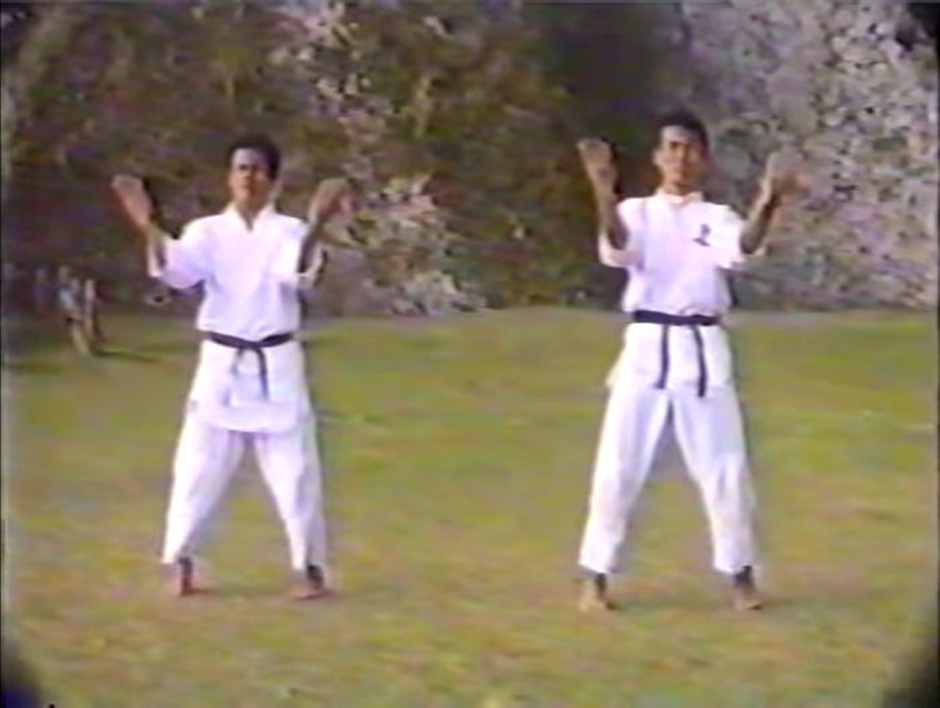
The Motobu Udun dii has basic forms called Muutu dii. There are two kinds, called ichi (one) and ni (two). The first is done with clenched fists, the second with open hands. The images below show Muutudii ni performed with open hands. 

https://www.youtube.com/watch?v=7A5k4emukhA

It resembles the Sanchin of the Gōjū school, but according to Master Uehara Sekichi, it is very different from the kata of the Gōjū-ryū. In fact, in this school one performs this kata with clenched fists, and, in this case, one performs Muutudii with open hands. In addition, Sanchin is accompanied by a particular breath called ibuki (forced breathing), whereas in Muutudii is natural. In addition, in the Gōjū, the toes are oriented inwards, according to an "internal hachimonji position: uchi hachimonji", but in Muutudi, they are roughly parallel. And also, the general posture or the way to lock the knees is also different. 

Master Uehara learned it from Master Motobu Chôyû, but as in other schools there is no Muutidi, I initially thought in the past that it was a creation of Master Chôyû. However, several decades ago, I heard disciples of Master Uehara from the 1950s say, “Back then, we called him Sanchin!” ", I then came to think that perhaps Muutudi is Sanchin". In this case, this would mean that originally, the Sanchin of the Gôjû school was done in a form close to an execution with open hands and with natural breathing.

The current Muutudii is carried out according to the model: move forward three steps and turn around, move forward again by three steps and turn around, and once again move forward three steps. I learned from disciplines of the time that this form was established around the time of the first Motobu-ryû Sashiki Demonstration which took place in Sashiki (now Nanjô) in 1974. Until then, it seems that the The execution model consisted of starting from one wall and moving towards the opposite wall, and when you reached it, you turned around and moved forward again. In other words, it was not a kata with a fixed form.

According to Higa Kiyohiko who had learned with master Uehara in the years 1950–1960, there was this format, but also a fixed form and his father (Higa Seitoku) had learned it. So would this mean that from the beginning, there was indeed a fixed form for Muutudii? As Master Uehara taught different movements to different disciples, this is a plausible version. Otherwise, there is also a Sanchin transmitted by Matsumura Sôkon, called “Shô Sanchin” [“Shô” being the other reading of the pine character “matsu” which happens to be the first sign of Matsumura’s name].

So, was there a Sanchin in the shurite?, many intrigued people will ask.

In fact, in addition to Master Uehara, the current sôke, Motobu Chôsei, heard from Mr. Miyagi Chôjô, a person originally from Okinawa who lived in his neighborhood, a testimony according to which Master Chôyû taught Sanchin.

  (Photograph: from left to right: the family of Motobu Chôsei, Uehara Seikichi, and jumping a person Miyagi Chôjô: Osaka, 1976)

It seems that Mr. Miyagi learned a little karate from Master Chôyû for a short time. And according to him, the latter then taught Sanchin. Furthermore, this same Mr. Miyagi told the legatee of our school the following thing. “Among Master Chôyû’s disciples, there was a truly gifted young man who was extraordinarily powerful. When he made Sanchin, the grass that passed under his feet was torn out.”

This is how there was indeed a Sanchin in the shurite. However, why did this kata suddenly disappear? This is another mystery in the history of karate.


Sunday, 22 October 2023

SanZhan or Sanchin?


Before I get started, please note I did not learn Sanchin as a part of the core syllabus from my Dojo.  Rather from a friend, PJ Broomhall, who teaches it as a part of his Bu Kai syllabus.   Firstly, I learnt it out of curiosity, as it is labelled as one of the three "core" Kata of Karate (along with Naihanchi and Tensho #1).   I then added it directly to my own repertoire as a part of my CBT/Karate routine (#2) that I use to remain calm and focus.

This routine has three elements, for Mindfulness, Tensioning and Relaxation.  Sanchin, used to develop the "iron body" techniques of Karate, seemed to be the absolutely natural Kata for the Tensioning portion of the routine.   Not done fully in the style that many Goju teachers would approve, but at Firstly, least tensioning the arms and legs to make the arms rigid in the legs "rooted".

My curiosity was piqued about the kata after watching Jesse Enkamp's China series (#3) on YouTube.  There may be some dispute about the veracity of the claim to have found the oldest Kata, but there can be no doubt at all about the genuine nature of the Kung Fu featured.  SanZhan was the Crown Jewel of the series.  It was claimed to be the root of Seisan, which is a possibility.  What is undeniably true is that it is the root form that led to Sanchin (#4).

Sanchin is known mainly for its association with Iron Body an Goju Ryu, but although the Karate kata is simplistic in appearance, its roots tell that there is much more to it.   Although many may use it simply as a body training kata, it embodies fighting techniques as well. I have been lucky enough to listen to many talks and train online with many people that I would probably never have met, but for Covid.  Two of these, Les Bubka and PJ Broomhall, quite happily consider and teach how the Kata can be applied.

Therefore, I was both amused and saddened by a member of the Karate world saying that Sanchin is only intended for and should only be used for, body training and conditioning.   It seems that some of the extended family still live in denial of the roots of Karate and that any kata derived from Kung Fu are not just going to be "training" kata. (An example of a Chinese training form would be the likes of "8 brocades", which would never be translated into karate #5).

I have the pleasure of slowly learning some aspects of Five Ancestors Boxing from online lessons with Russ Smith, and some of the material seemed directly aligned with Sanchin, though less stylised.  The material in question is in no way intended as body training and has an explicit direct follow on from the deflecting aspect of the crossing arms in a double outward worlds block.

To show what I mean, this is a video of my amended version of Sanchin, showing the more attacking potential I can see hidden in the movements:


Sanchin modified to incorporate Five Ancestors techniques: 

1) Turns half front, half back, followed by leg sweep. 
2) Outward crossing of arms open handed, then bringing down as hooking hand to trap the opponent's arms. 
3) In place of a punch, back hand hook turns into a ridge hand “bump" to the trapped arm, followed by a finger strike up the line of the arm into the throat.

Whilst this is strictly speaking neither SanZhan or Sanchin, I don't think that most people would deny the Sanchin base, or argue too much with the intent of the Five Ancestors added techniques.  Of course, apart from our doctrinally blinkered brethren.  So maybe to let them live happily in the belief that Sanchin is solely a training/conditioning kata, by referring to anything derived with purposeful intent as SanZhan? 


REY 22/10/2023


#1 The Birth of Karate

#2 Kata and CBT

#3 Karate Nerd In China (Ep 5)

#4 SanZhan, Sanchin and Seisan

#5 Eight Brocades


Tuesday, 16 May 2023

Mindfulness, Tensioning, Breathing and Relaxing (with PJ Broomy)


I have a friend in Australia, Paul Broomall (aka PJ Broomy), who during Covid was one of the online teachers who helped out with Guest Lessons, along with Les Bubka amongst many others. due to some similarities in health conditions, and it seems outlook on life, we became friends, and we have continued to work together online since then. However, last winter and our own personal circumstances since then, we only managed to arrange our first online session together for 14th of May. PJ kindly consented to become the first victim to try out the CBT kata I have been using for the last 18 months or so, so I was both somewhat excited and worried by showing had been doing it and the reasoning behind it.

To recap, that kata in question are Naihanchi (or Tekki) Shodan, Sanchin and Tensho. The principles of CBT being worked on are Mindfulness, Tensioning, Relaxation and Breathing.

 Naihanchi (Tekki) Shodan I use for mindfulness, which in CBT is feeling every part of your body, both statically and when in motion. The kata is done at whatever speed you feel comfortable with at the time, but ensuring that you concentrate on how your body is moving and where you end up. It doesn't need to be the perfect kata, neither do any of the three.

The second kata is Sanchin, which I use for Tensioning. This one is PJs, though a variation on the way he does it. He showed me the version where by turning your wrists you can tension your arms to rigidity. I do the same with my legs (I think this picked up in a seminar from Okinawa online, where rooting your feet was said to be important). Sanchin as used by Goju Ryu seems to be used extensively for this, so seemed a natural choice.

The third kata is Tensho, for Relaxation and Breathing. Originally, I was taught Tensho as a breathing kata by Noah Legel, to help with my COPD. Then Les Bubka showed me how it could be used for relaxation (Teisho). Combining the two seemed the perfect choice for what I wanted to achieve. There are two versions that I do, one for full space and one for limited space. The latter in arm kata only. However, both work the same for me.

In short, by the third set of hand movements in Tensho, my breathing is comfortably in synch with the arm movements, I find myself feeling relaxed and with a clear mind. PJ seemed to enjoy the exercise.....

=
 

PJ Broomy's view of what we went through: "A very interesting way of practicing kata. Naihanchi with a focus on mindfulness, Sanchin on muscular tension and Tensho for relaxation. There is no rule saying each kata must be done a particular way. To the contrary our Okinawan masters have been documented encouraging us to make karate our own. Bob is doing this and getting more and more out karate as a result.

Recently we applied Bob’s method to these three core kata in the dojo. Focusing on where the body was in time and space during Naihanchi not only gave the kata another dimension but lead to some very effective bunkai/oyo latter in the class.


Sanchin is known for tension however we focused on proper spine alignment when applying that muscular tension. This also helped induce some fatigue that assisted with the transition into Tensho. Tensho was performed in a more relaxed manner with a distinct focus on breathing. This is a great way to round out what is an excellent routine for any karateka to do."


As this was the first time I had actually shown someone else, and they did it for the first time themselves (I had no idea he got his dojo to try it out later), I thought it worthwhile sharing the results. Hope some of you might find it of interest. REY/PJB 16/05/2023


Sunday, 22 January 2023

Shu Ha Ri


 Events towards the end of last year disheartened me somewhat, and as a result I felt little inclination to post blogs or record videos.  However, I never gave up doing the core that I use for my own purposes (relaxation, clearing the mind and breathing).  As a part of my New Year's resolution, I decided to get back to doing what I enjoy and start increasing the amount of training I do to start getting back to a healthy level of fitness.

In the first instance, I intend to do this by increasing the amount I do based around my core kata.  For those of you that are perhaps reading for the first time, these consist of Naihanchi, Sanchin and Tensho, based on the work I did for CBT to improve my mental health.

Naihanchi - (mostly Shodan, but as I increase the amount of work I do, intend to extend to Nidan and perhaps Sandan, though this isn't one of the kata I formally learned at my original dojo).  This I use for body awareness, how my body moves and the positioning of body elements during the execution of the kata.

Sanchin for body tensioning.

Tensho for deep breathing in a relaxed manner.

What persuaded me to do this was a friend who said that although still I was a novice, my use of kata for these specific purposes was something I had made my own.  As he termed it,  Shu Ha Ri, which I take as a pretty big compliment.  I still have so much to learn, and know that to advance my knowledge in a practical way, I need to return to the dojo.  Family circumstances still preclude this just now, but it is what I aim for.

In the mean-time, that somebody I respect tells me what I have done is of merit is enough for me.

REY 22/01/2023


Sunday, 20 March 2022

Kata with Sai

I haven't formally been trained in Sai, but some time back, attending a session online with Sensei Tuari Dawson wetted my appetite.  Since been given Sai as a birthday present, I have occasionally used Sai with kata to see how they might fit.  This year however, due to personal circumstances, most of my practice and training has been solo and I found myself picking up the Sai more often.

Sanchin with Sai

I started off with Sanchin, which for some reason seemed to fit, and have been doing that for a couple of months now.  However, on my birthday, a message from one of my FB friends took me back to a video shared with me a couple of years ago.  It was of another standard kata, but done with Sai.  The first time round, I hadn't recognised it, but it was essentially Pinan Nidan.  Well, not quite.  

Pinan Nidan with Sai

I have tried it out a few times, and this weekend if formed the basis of a discussion with PJ Broomy.  Two things came out of this:

Firstly the kata is actually a blend of Taigyoku Shodan and Pinan Nidan
Secondly, I need to work on my Sai manipulation, as I still have a lot to learn.

PJ has kindly guided me to some YouTube material by Tuari Dawson, so time to get studying....

Sunday, 28 November 2021

Kata and CBT.


I'm currently undertaking an online course in Cognitive Behavioural Therapy to help me unravel the Gordian knot described in "Suicidal thoughts".  Part of this is to practice three sets of techniques each day to help with mindfulness and relaxation.  Basically you have:
  • Awareness, going through each part of your body in turn to explore what you can feel
  • Tensioning, tensing and relaxing muscles to help relieve tension
  • Breathing, feeling each breath to bring you into the now and focus on the present
This reminds me of a lot of the techniques I have learnt through Karate, such as the relaxation and cardio slow kata learnt with Robey Jenkins, the tensioning in Sanchin from PJ Broomy and the breathing learnt from Noah Legel, in Tensho.


As a result, and due to my need to get back into deliberately practice every day, I decided to see whether I could combine the two.  So I perform Naihanchi Shodan, Sanchin and Tensho in sequence.  Naihanchi, I perform slowly, paying attention to how my body moves and feels.  Sanchin, I am currently experimenting with tensioning on 1 rep in 2 and 1 rep in three for the whole body and relaxing in between.  In Tensho, it is a case of using the breathing much as is done in Mokuso, to empty the mind and come into the present.


The two videos shown are from the last couple of days, one with the 1 in 2 Sanchin, the other with the 1 in 3 Sanchin.  Very much a work in progress, but ironic that I chose without thinking the three kata labelled as fundamental kata to Karate by Miyagi Chojun.  I didn't even think about that until it was pointed out by PJ Broomy.  

Will document how it goes in a later blog.


Sunday, 3 January 2021

A Nerd post, SanZhan, Sanchin and Seisan

This isn't a historical post, let's make this clear; rather it's a train of thought based upon observations I have made, in part based on some presented material I have been exposed to.   The link between Seisan and SanZhan I looked at in one of my previous blogs:


Seisan as nerd and for health

However, I wanted to have another look at SanZhan and the route started again with"Karate Nerd in China"  Jesse had somebody named Will helping him on the journey, so I decided to look him up.  This turned out tp be Will Wain-Williams, who has his own YouTube channel, "Monkey Steals Peach", and there, sure enough, was even more material from the Jesse Enkamp trip, including the full form of SanZhan Jesse had referred to.

Also, there was under a Subsection, "Monkey offers Peach". a whole archive of the different forms of SanZhan that Will had come across in his travels:

Monkey gives Peach - SanZhan Archive (no longer available)

The interesting thing was, Will identified the kata associated with it as Sanchin, not Seisan.  In truth, that ties in with the various names I seem to have heard for both Kata, SanZhan and Sanchin both refer to the number three, one of the popular names for the form and kata being the "three battles".  Seisan apparently refers to the number 13.  There is is a large amount of reference material which refers to Sanchin being specifically brought over to Okinawa from China, but not a great deal stated about Seisan.

However, apart from Jesse's video, there are other reference points that cite Seisan being linked to SanZhan, so this set a seed that both Seisan and Sanchin are related and derived from the same Chinese form, SanZhan. Sanchin seems to concentrate on the similar opening elements found in each of the different forms of SanZhan, while the diverse forms of Seisan, reflect the many variations of SanZhan found in China. Sanchin concentrates on very specific core techniques taught in the styles of karate where it is used as the base kata, whilst Seisan incorporates the diverse techniques used in fighting.

I decided to ask Will about this, and whilst he was knowledgeable about the Sanchin relationship to SanZhan, he referred me to an interview he did with Russ Smith (author of  "Principle-Driven Skill Development: for Traditional Martial arts"), for further insight.

Russ Smith - SanZhan, Sanchin and Seisan

Russ Smith in the interview gives his theory, having studied both Five Ancestors Boxing and Goju Ryu, Seisan is a four directional version of SanZhan.  So, SanZhan could be the root form of both Sanchin and Seisan.  Sanchin being the core and Seisan adding in the other elements.

For the sake of completeness, I have added a link to the forms of Seisan I found in my search for the first blog.

YouTube Playlists (Seisan)

I would be interested to hear what other people think.